
Introduction
In 2026, the way customers discover businesses has completely changed. Before visiting a store, booking a service, or making a purchase, people search online first. Whether someone is looking for a nearby restaurant, a digital marketing agency, a salon, or even a local plumber, their journey almost always starts with Google or AI-powered search platforms.
Today, if your business does not have a website, many customers may assume your business is outdated, untrustworthy, or inactive. Social media platforms help businesses gain visibility, but they are no longer enough on their own. Customers now expect brands to have a professional online presence where they can learn more, view services, check reviews, contact the business, or make purchases instantly.
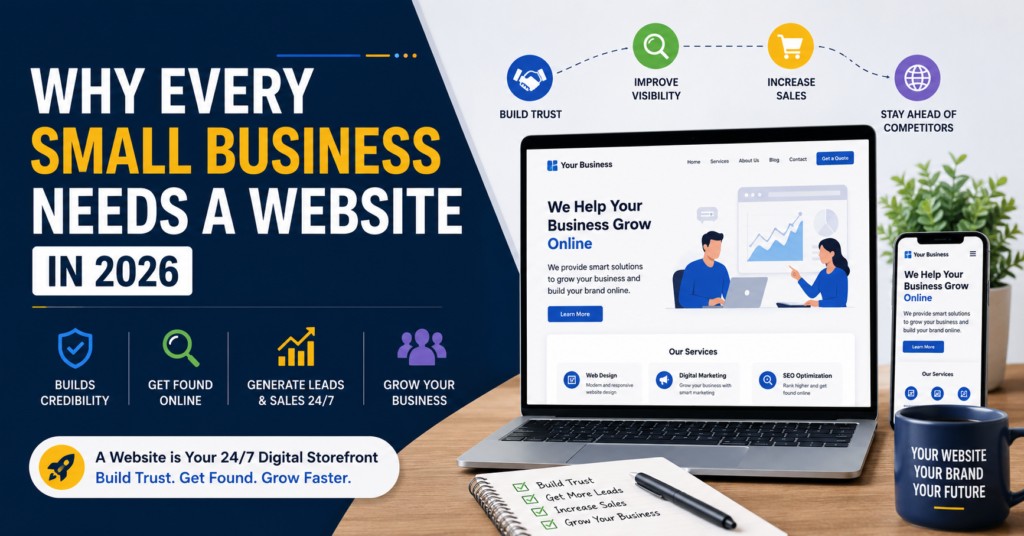
A website has become one of the most powerful tools for small businesses in 2026. It works as a digital storefront that stays active 24/7, helping businesses generate leads, build trust, and grow consistently. Even small local businesses now compete online, and those without websites are often left behind.
From local shops and freelancers to startups and service providers, every business today needs a website to survive and grow in the modern digital world.
In this guide, you will learn:
- Why websites are essential for small businesses in 2026
- The biggest benefits of having a business website
- Common myths about websites
- Features every modern website should include
- How websites help businesses generate leads and sales
- Future trends shaping business websites
Let’s begin by understanding what a small business website actually is.
What is a Small Business Website?
A small business website is a professional online platform that represents a business on the internet. It provides information about the company, its products, services, contact details, and other important business information.
Think of a website as your digital office or online showroom. Even when your physical store is closed, your website continues working for your business.
A professional website allows customers to:
- Learn about your business
- Explore products or services
- Contact you easily
- Book appointments
- Read customer reviews
- Make purchases online
- Trust your brand more
In 2026, websites are no longer only for large companies. Affordable website builders, AI tools, and digital marketing platforms have made websites accessible for everyone.
Types of Small Business Websites
Different businesses require different types of websites. Here are the most common types:
1. Service-Based Websites
These websites are designed for businesses that provide services rather than physical products.
Examples:
- Digital marketing agencies
- Plumbers
- Electricians
- Lawyers
- Consultants
These websites usually include:
- Service pages
- Contact forms
- Testimonials
- Booking options
2. Ecommerce Websites
Ecommerce websites allow businesses to sell products online directly.
Examples:
- Clothing stores
- Electronics shops
- Beauty brands
- Handmade product stores
Features often include:
- Product catalogs
- Shopping carts
- Online payments
- Order tracking
3. Portfolio Websites
Portfolio websites showcase previous work, projects, or achievements.
Popular among:
- Graphic designers
- Photographers
- Freelancers
- Web developers
- Content creators
4. Personal Brand Websites
Many entrepreneurs and professionals now build personal brand websites to establish authority online.
These websites usually include:
- About section
- Blogs
- Case studies
- Social media links
- Lead generation forms
5. Landing Pages
Landing pages are focused single-page websites designed to generate leads or sales.
Businesses use them for:
- Advertising campaigns
- Product launches
- Webinar registrations
- Lead generation
No matter the type of business, having an online presence in 2026 is no longer optional.
Why Every Small Business Needs a Website in 2026
1. Builds Business Credibility
One of the biggest reasons businesses need a website is credibility.
Modern customers trust businesses that appear professional online. When someone searches for your company and cannot find a website, they may question whether your business is genuine.
A professional website instantly improves trust because it shows:
- Your business is active
- Your services are legitimate
- Customers can contact you easily
- Your brand is serious about growth
In competitive industries, credibility can make the difference between gaining or losing customers.
For example:
Imagine two digital marketing agencies:
- One has a professional website with testimonials and service pages.
- The other only has an Instagram page.
Most customers will naturally trust the business with a website more.
2. Helps Customers Find You Online
Every day, millions of people search online for products and services near them.
Searches like:
- “best salon near me”
- “digital marketer in Mumbai”
- “affordable web designer”
- “restaurant near me”
are incredibly common in 2026.
Without a website, your business has very limited visibility online.
A website helps your business:
- Appear on Google
- Rank in local search results
- Get discovered by new customers
- Generate organic traffic
When optimized properly with SEO, your website becomes a lead generation machine.
3. Generates Leads and Sales 24/7
Unlike physical stores, websites never close.
Your website can:
- Collect leads while you sleep
- Generate inquiries automatically
- Accept online bookings
- Sell products 24/7
This is one of the biggest business website benefits in 2026.
For example:
A customer searching for services at midnight may fill out your contact form. The next morning, you already have a new business inquiry waiting.
That means your website works even when you are offline.
4. Improves Brand Identity
Branding is extremely important in today’s competitive digital market.
A website helps businesses create:
- A professional image
- Brand consistency
- Unique identity
- Strong market positioning
Using custom:
- Colors
- Fonts
- Logos
- Visual design
- Messaging
you can create a memorable brand experience.
Without a website, businesses often rely completely on social media platforms where branding opportunities are limited.
5. Works Better Than Social Media Alone
Many small businesses think social media is enough.
However, relying only on Instagram, Facebook, or TikTok is risky.
Why?
Because:
- Algorithms constantly change
- Your account can get restricted
- Organic reach keeps decreasing
- Platforms control your visibility
A website gives you full control over your online presence.
Social media should support your website — not replace it.
The smartest businesses in 2026 use:
- Social media for attention
- Websites for conversions
That combination creates powerful business growth.
6. Supports Digital Marketing Campaigns
A website is the foundation of digital marketing.
Without a website, running effective:
- SEO campaigns
- Google Ads
- Content marketing
- Email marketing
- Retargeting campaigns
becomes difficult.
For example:
When someone clicks your advertisement, they should land on a professional website that converts visitors into customers.
Websites improve marketing performance by:
- Increasing trust
- Providing information
- Capturing leads
- Tracking customer behavior
Businesses without websites lose many potential conversions from advertising campaigns.
7. Helps in Local SEO and Google Rankings
Local SEO is more important than ever in 2026.
Customers constantly search for nearby businesses using mobile devices.
A website helps businesses rank in:
- Google Maps
- Local search results
- AI search recommendations
This is especially important for:
- Restaurants
- Gyms
- Salons
- Clinics
- Local service providers
A properly optimized website increases your chances of appearing when customers search for services in your area.
For local businesses, visibility equals revenue.
8. Displays Products and Services Professionally
A website allows businesses to present their offerings professionally.
Instead of sending customers random photos through WhatsApp or social media DMs, businesses can showcase:
- Products
- Services
- Pricing
- Packages
- Portfolios
in an organized way.
Professional presentation increases:
- Customer confidence
- Conversion rates
- Purchase intent
Customers prefer businesses that look organized and professional online.
9. Builds Customer Trust Through Testimonials and Reviews
Reviews strongly influence purchasing decisions.
A website allows businesses to showcase:
- Testimonials
- Client feedback
- Case studies
- Success stories
This creates social proof.
When potential customers see positive reviews from previous clients, they feel more confident choosing your business.
In 2026, trust is one of the most valuable digital assets.
10. Gives Competitive Advantage
Many small businesses still do not have modern websites.
This creates a huge opportunity.
A fast, optimized, professional website can help you outperform competitors who:
- Have outdated websites
- Ignore SEO
- Depend only on social media
- Lack online professionalism
In many industries, a strong online presence alone can become your competitive advantage.
11. Helps Businesses Scale Faster
Businesses that want long-term growth need scalable systems.
Websites support scaling by:
- Automating lead generation
- Reaching larger audiences
- Reducing manual work
- Improving customer communication
As businesses grow, websites become even more valuable.
Instead of answering repetitive questions manually, businesses can provide:
- FAQs
- Service details
- Pricing
- Booking systems
directly on their website.
This saves time and improves efficiency.
12. Enables Online Booking, Payments, and Automation
Modern websites can automate many business processes.
Features such as:
- Online appointment booking
- Payment gateways
- Automated emails
- CRM integration
- Chatbots
make operations smoother.
For example:
A salon website can allow customers to:
- View services
- Check pricing
- Select appointment slots
- Pay online
without calling the business.
Automation improves customer experience and reduces workload.
13. Provides Customer Insights Through Analytics
Websites provide valuable customer data.
Using analytics tools, businesses can understand:
- Visitor behavior
- Popular pages
- Traffic sources
- Customer interests
- Conversion rates
This helps businesses make smarter decisions.
Data-driven businesses usually grow faster because they understand their audience better.
14. Cost-Effective Marketing Tool
Traditional advertising is expensive.
However, a website can generate long-term results at a relatively low cost.
Compared to:
- Newspaper ads
- Billboards
- Flyers
- TV ads
a website offers better ROI.
Once your website ranks on Google, it can bring free organic traffic for months or even years.
That makes websites one of the most affordable marketing investments for small businesses.
15. Essential for Mobile Users
In 2026, most internet users browse through smartphones.
Customers expect websites to:
- Load quickly
- Look good on mobile
- Be easy to navigate
Mobile-friendly websites improve:
- User experience
- SEO rankings
- Conversions
Businesses without mobile-optimized websites lose significant traffic and potential customers.
The Impact of AI and Digital Trends in 2026
Technology is evolving rapidly.
AI-powered search engines, smart assistants, and voice search are transforming how customers find businesses online.
Today, people search using conversational phrases like:
- “best digital marketing agency near me”
- “top salon open now”
- “affordable website designer in Mumbai”
AI systems now recommend businesses based on:
- Website quality
- SEO optimization
- User experience
- Content relevance
Businesses without websites may become almost invisible in AI-driven search ecosystems.
Additionally:
- Mobile-first browsing continues growing
- Website speed matters more
- Voice search optimization is becoming essential
In 2026, businesses need websites not just for visibility — but for survival in the digital economy.
Common Myths About Business Websites
Many businesses still avoid creating websites because of common misconceptions.
Let’s break them down.
Myth 1: “Social Media is Enough”
Social media helps visibility, but it is not a replacement for a website.
Websites offer:
- Better control
- Higher professionalism
- SEO benefits
- Conversion optimization
The best strategy combines both.
Myth 2: “Websites Are Expensive”
Modern website builders and AI tools have made websites affordable.
Today, businesses can launch professional websites with relatively low investment.
Considering the long-term benefits, websites provide excellent ROI.
Myth 3: “Only Big Companies Need Websites”
This is completely outdated.
Small businesses benefit even more from websites because they help compete with larger brands online.
Local businesses especially gain major advantages from local SEO and Google visibility.
Myth 4: “I Get Customers Through Referrals Only”
Even referral customers often search online before contacting a business.
If they cannot find your website, you may lose credibility instantly.
A website supports referrals by reinforcing trust.
Features Every Small Business Website Should Have
In 2026, websites need more than just attractive design.
Modern business websites should include:
- Mobile responsiveness
- Fast loading speed
- SEO optimization
- SSL security
- Clear call-to-actions
- Contact forms
- WhatsApp integration
- Google Maps integration
- Testimonials
- Service pages
- Blog section
- Professional branding
- Easy navigation
These features improve user experience and increase conversions.
FAQs
1. Why is a website important for small businesses in 2026?
A website helps businesses build credibility, generate leads, improve online visibility, and compete effectively in the digital marketplace.
2. Can social media replace a business website?
No. Social media supports marketing efforts, but websites provide full control, better branding, SEO benefits, and higher trust.
3. Are websites expensive to build?
Not anymore. Many affordable website builders and AI tools allow businesses to create professional websites at low cost.
4. How does a website help with SEO?
Websites can rank on Google and attract organic traffic through optimized content, keywords, and local SEO strategies.
5. What type of businesses need websites?
Almost every business can benefit from a website, including restaurants, salons, freelancers, agencies, ecommerce stores, coaches, and local service providers.
Conclusion
In 2026, having a website is no longer optional for small businesses.
Customers expect businesses to exist online. Without a website, companies risk losing visibility, credibility, leads, and revenue.
A professional website helps businesses:
- Build trust
- Generate leads
- Improve branding
- Support digital marketing
- Rank on Google
- Compete effectively
Whether you run a local business, startup, agency, or personal brand, investing in a website is one of the smartest decisions you can make for long-term growth.
The digital world is evolving quickly, and businesses that adapt early will have the biggest advantage.
Now is the perfect time to build your online presence and future-proof your business for 2026 and beyond.
Pingback: Digital Marketer in Jogeshwari: Grow Your Business with Proven Digital Marketing Strategies - Digital Abu Shadique