
Search Engine Optimization (SEO) is one of the most effective digital marketing strategies for businesses that want sustainable online growth. Yet, one question continues to dominate conversations between business owners and SEO professionals:
How long does SEO take to show results?
It’s a fair question. After all, every business invests time, money, and effort into improving its website. Naturally, everyone wants to know when those investments will start paying off.
The honest answer is this:
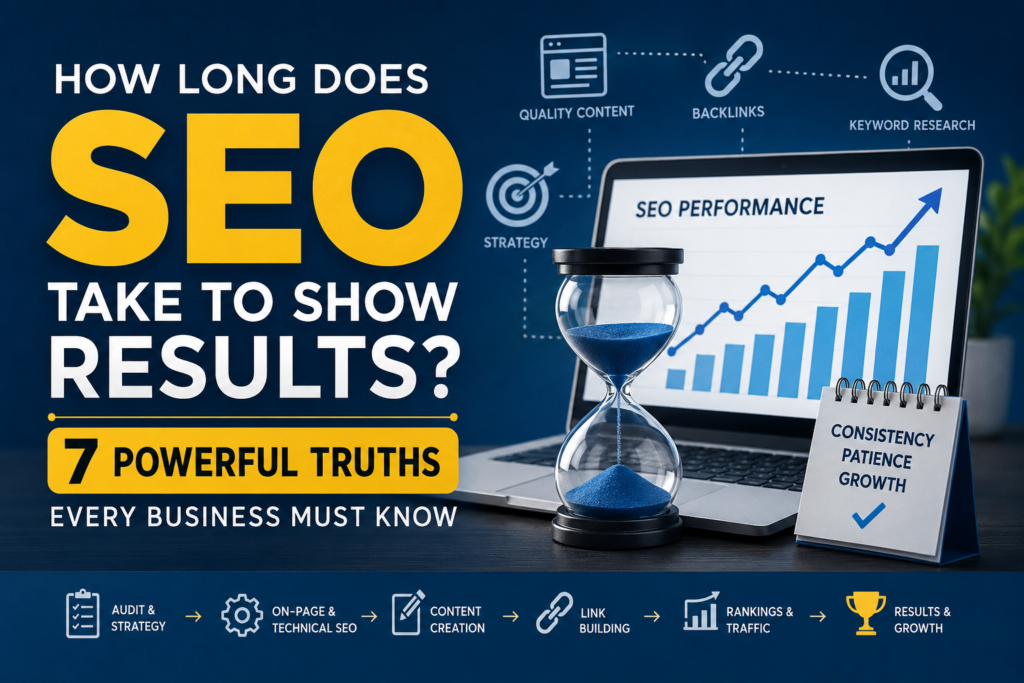
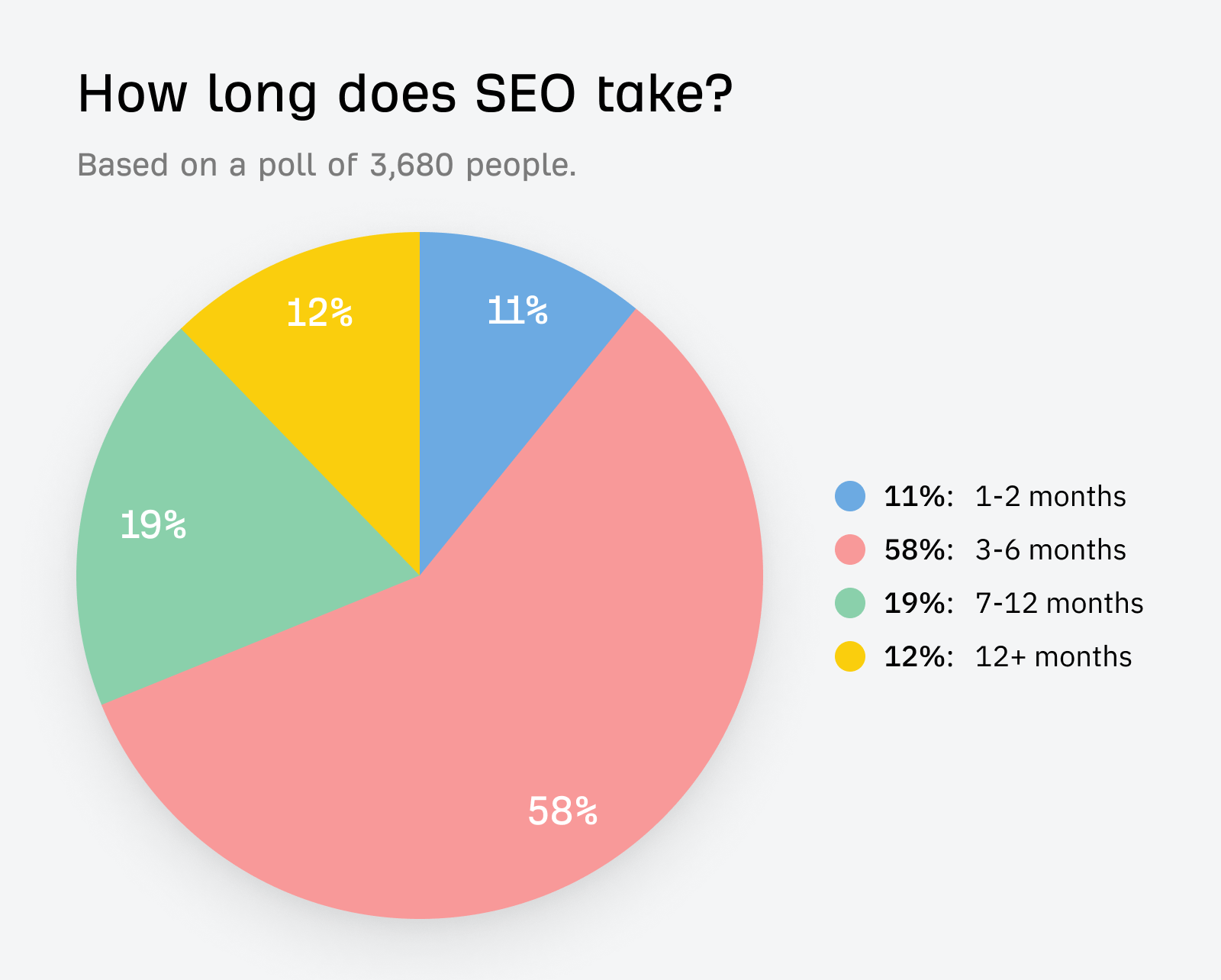
SEO typically takes between 3 to 6 months to show noticeable improvements, while competitive industries often require 6 to 12 months or longer to achieve significant rankings and consistent organic traffic.
Although that timeline may seem lengthy, it’s important to understand that SEO is not a shortcut. Unlike paid advertising, where visibility begins almost immediately, SEO focuses on building long-term authority and trust in the eyes of search engines like Google.
Think of SEO as planting a tree.
You don’t water a seed today and expect a fully grown tree tomorrow. Instead, every optimization you make strengthens your website little by little until it becomes an authority that consistently attracts visitors.
The businesses that succeed with SEO aren’t always the ones with the biggest budgets. They’re the ones who stay consistent.
What Does “SEO Results” Actually Mean?
Many people believe SEO success simply means ranking #1 on Google.
In reality, SEO results happen in stages.
Before your website reaches the first page, several positive changes usually occur behind the scenes.
These include:
- Better keyword rankings
- Increased website impressions
- Higher click-through rates
- More organic traffic
- Improved domain authority
- Faster website performance
- Better user engagement
- More inquiries and conversions
For example:
Imagine you own a digital marketing agency in Mumbai.
Initially, your website might rank on page six for Digital Marketing Consultant in Mumbai.
After several months of optimization, it gradually climbs to page three.
Then page two.
Eventually, page one.
Every improvement along the way increases your visibility and brings more qualified visitors to your website.
SEO is not an overnight transformation.
It’s a journey of continuous improvement.
Why SEO Takes Time
One of the biggest misconceptions about SEO is that Google simply “updates rankings” every few weeks.
In reality, Google’s search algorithm evaluates hundreds of ranking factors before deciding where your website belongs.
Some of these factors include:
- Website quality
- User experience
- Mobile friendliness
- Page speed
- Content relevance
- Search intent
- Internal linking
- Backlink profile
- Website authority
- User engagement signals
Google’s primary goal is simple:
Deliver the most useful result for every search.
That means Google won’t immediately trust a brand-new website simply because it publishes a few articles.
Instead, it watches how users interact with your content over time.
Questions Google silently asks include:
- Do visitors stay on the page?
- Do they leave immediately?
- Are other trusted websites linking to this page?
- Is the content original?
- Does the website answer users’ questions better than competitors?
Only after gathering enough confidence does Google reward a website with higher rankings.
This process naturally takes time.
The SEO Timeline: What to Expect
Every website is different.
However, most SEO campaigns follow a similar pattern.
Month 1: Research and Foundation
The first month usually focuses on planning rather than rankings.
During this stage, SEO professionals perform:
- Comprehensive website audit
- Keyword research
- Competitor analysis
- Technical SEO improvements
- Website speed optimization
- Mobile usability fixes
- Crawl error corrections
- Google Search Console setup
- Google Analytics configuration
Although rankings rarely improve immediately, this phase creates the foundation for future growth.
Think of it like building a house.
Without a strong foundation, nothing else lasts.
Months 2–3: Content and Optimization
Once technical issues are resolved, attention shifts toward content.
Activities often include:
- Publishing high-quality blog posts
- Optimizing service pages
- Improving existing content
- Creating internal links
- Building topical authority
- Optimizing images
- Writing compelling meta titles and descriptions
Around this stage, many websites begin seeing:
- More impressions
- Slight ranking improvements
- Small increases in organic traffic
- Better keyword positioning
Results are usually modest but encouraging.
This is often the point where many businesses make a mistake.
They become impatient.
Unfortunately, stopping SEO after two or three months is like quitting the gym after your first week.
The progress has started—but it’s far too early to see the full transformation.
Months 4–6: Momentum Begins
This is where many businesses finally notice meaningful improvements.
Google has had enough time to crawl your new content, understand your expertise, and evaluate user behavior.
At this stage, you may experience:
- Page one rankings for low-competition keywords
- Significant growth in impressions
- Consistent increases in organic traffic
- Higher-quality leads
- Better conversion rates
- More pages appearing in search results
For local businesses, this period often brings stronger visibility in local searches as well.
If your SEO strategy includes local optimization, Google Business Profile enhancements, and consistent citations, you may start attracting customers directly from local search results.
However, the journey doesn’t end here.
In fact, this is where the real growth begins.
Months 6–12: Where SEO Begins to Deliver Real Results
By the six-month mark, a well-executed SEO strategy often starts producing noticeable business outcomes. If you’ve consistently published quality content, optimized your website, improved technical performance, and earned trustworthy backlinks, Google begins to view your website as a reliable source of information.
This is when SEO shifts from “building the foundation” to generating measurable growth.
Many businesses experience:
- Consistent increases in organic traffic
- Higher rankings for competitive keywords
- More qualified leads
- Better conversion rates
- Increased brand visibility
- Improved trust among potential customers
Instead of ranking for just a handful of keywords, your website may begin appearing for dozens—or even hundreds—of related search terms.
For example, a digital marketing consultant who originally targeted “SEO services in Mumbai” may also start ranking for keywords such as:
- Best SEO consultant near me
- Local SEO expert
- SEO specialist in Mumbai
- Website SEO services
- Organic traffic growth
- Technical SEO consultant
This happens because Google starts recognizing your website as an authority on the subject, not just for a single keyword.
Beyond 12 Months: Sustainable Long-Term Growth
SEO is an investment that compounds over time.
Unlike paid advertising, where traffic stops the moment you stop spending, SEO continues delivering value long after your content is published.
After one year of consistent optimization, many websites enjoy:
- Strong domain authority
- Hundreds of ranking keywords
- Stable monthly traffic
- Reduced dependence on paid advertising
- Higher customer trust
- Better return on investment (ROI)
This is one of the biggest advantages of SEO.
Every optimized page becomes a long-term asset that can continue attracting visitors for years with regular updates.
Think of SEO as building a digital library. Every helpful article, optimized service page, and informative guide adds another valuable resource that search engines can recommend to users.
10 Factors That Affect How Long SEO Takes
Not every website follows the same timeline. Some see growth within a few months, while others may need a year or more.
Here are the biggest factors that influence how quickly SEO delivers results.
1. Website Age
Older websites often have an advantage because they already possess a history with search engines.
Google has had time to evaluate:
- Website reliability
- User engagement
- Existing backlinks
- Content quality
- Brand reputation
A brand-new website starts from zero.
That doesn’t mean new websites can’t rank—it simply means they need more time to earn Google’s trust.
2. Competition Level
Competition has a huge impact on SEO timelines.
Let’s compare two keywords:
| Keyword | Difficulty |
|---|---|
| Best Bakery in Jogeshwari | Low |
| Digital Marketing Agency | Very High |
Ranking for a local keyword may take only a few months.
Ranking for a broad, highly competitive keyword can take significantly longer because you’re competing against established websites with years of authority.
The more competitive the industry, the more patience and consistency SEO requires.
3. Content Quality
Google rewards content that genuinely helps users.
High-quality content typically:
- Answers user questions clearly
- Covers topics in depth
- Uses credible sources
- Is easy to read
- Includes original insights
- Provides real value
Thin, copied, or outdated content rarely performs well in search results.
Instead of publishing dozens of short articles, focus on creating fewer but more comprehensive pieces that fully satisfy search intent.
4. Technical SEO
Even the best content can struggle if your website has technical issues.
Some common technical problems include:
- Slow page speed
- Broken links
- Duplicate content
- Crawl errors
- Poor mobile experience
- Missing structured data
- Incorrect redirects
A technically optimized website allows search engines to crawl, index, and understand your pages more efficiently.
Regular technical audits are essential for maintaining strong SEO performance.
5. Backlink Quality
Backlinks remain one of Google’s strongest ranking signals.
However, quality matters far more than quantity.
One backlink from a respected, relevant website can carry more weight than dozens of links from low-quality or unrelated sites.
Effective ways to earn quality backlinks include:
- Publishing original research
- Writing guest articles
- Creating helpful guides
- Building relationships within your industry
- Producing shareable resources
Avoid shortcuts like buying backlinks or participating in link schemes. These tactics may provide short-term gains but can lead to penalties that are difficult to recover from.
6. Search Intent
Google wants to display pages that best match what users are looking for.
If someone searches:
“How long does SEO take to show results?”
They expect a detailed explanation—not a sales page promoting SEO services.
Understanding search intent is one of the most important aspects of modern SEO.
Before creating content, ask yourself:
- What problem is the user trying to solve?
- What information are they expecting?
- How can I provide a better answer than competitors?
When your content aligns with user intent, rankings tend to improve more quickly.
7. Consistency
One blog post isn’t enough.
Neither is optimizing your website once and forgetting about it.
Successful SEO requires consistent effort, including:
- Publishing fresh content
- Updating existing pages
- Monitoring rankings
- Improving user experience
- Fixing technical issues
- Building new backlinks
Businesses that treat SEO as an ongoing strategy almost always outperform those that see it as a one-time task.
8. Local SEO Optimization
For businesses serving a specific geographic area, local SEO can significantly speed up results.
Optimizing your:
- Google Business Profile
- Local citations
- Customer reviews
- Location pages
- NAP (Name, Address, Phone) consistency
can help your business appear in local search results and Google Maps, often faster than ranking for broad national keywords.
9. User Experience (UX)
Google pays close attention to how users interact with your website.
Positive user experience signals include:
- Fast loading times
- Easy navigation
- Mobile responsiveness
- Clear page structure
- Helpful content
- Low bounce rates
If visitors enjoy using your website, Google is more likely to view it as a valuable result.
10. SEO Strategy
Not all SEO strategies are created equal.
A successful campaign combines:
- Keyword research
- Technical optimization
- High-quality content
- Internal linking
- Link building
- Performance tracking
- Continuous improvements
Skipping any of these areas can slow your progress.
A well-rounded strategy delivers stronger, more sustainable results over time.
Why Some Websites Rank Faster Than Others
You may notice that one website reaches page one in four months while another struggles after a year.
This usually comes down to several factors working together.
Faster-growing websites often have:
- A clear content strategy
- Strong technical foundations
- Consistent publishing schedules
- High-quality backlinks
- Excellent user experience
- Low competition
- Experienced SEO management
On the other hand, websites that ignore SEO best practices often face delays, regardless of how long they’ve been online.
SEO isn’t just about patience—it’s about making the right improvements consistently.
Can You Speed Up SEO Results?
One of the most common questions after “How long does SEO take to show results?” is whether it’s possible to speed up the process.
The answer is yes—but only to a certain extent.
No one can guarantee first-page rankings within days or weeks. Google uses sophisticated algorithms that evaluate quality, relevance, authority, and user experience over time. However, by following proven SEO best practices, you can create the right conditions for faster growth.
Here are the most effective ways to accelerate your SEO progress.
1. Start with a Technical SEO Audit
Think of your website as a house. Before decorating the interior, you need to ensure the foundation is solid.
A technical SEO audit helps identify issues that may prevent Google from properly crawling and indexing your website.
Common issues include:
- Broken links (404 errors)
- Duplicate pages
- Slow loading speeds
- Missing meta tags
- Poor mobile usability
- Incorrect redirects
- Crawl errors
- Missing XML sitemap
Fixing these problems early makes it easier for search engines to understand your website and improves your chances of ranking faster.
2. Focus on Search Intent, Not Just Keywords
Years ago, SEO was largely about inserting keywords throughout a page.
Today, Google prioritizes content that satisfies the user’s intent.
Ask yourself:
- What is the visitor trying to learn?
- What problem are they trying to solve?
- What information would genuinely help them?
For example, someone searching “How long does SEO take to show results?” wants realistic expectations, not exaggerated promises.
When your content directly answers users’ questions, they tend to stay longer on your website. These positive engagement signals can support stronger rankings over time.
3. Create High-Quality, In-Depth Content
Content remains one of the strongest drivers of SEO success.
Rather than publishing dozens of short articles, focus on creating comprehensive resources that cover a topic in detail.
Great content should:
- Answer common questions
- Include practical examples
- Be easy to read
- Use clear headings
- Stay updated with current information
- Offer unique insights
When readers find your content genuinely helpful, they’re more likely to share it, link to it, and return to your website—all of which can strengthen your SEO.
4. Build Topic Authority
Google prefers websites that demonstrate expertise across an entire subject, not just one article.
Instead of writing a single post about SEO, build a content library.
For example:
Main Topic:
SEO
Supporting Articles:
- What Is SEO?
- On-Page SEO Checklist
- Technical SEO Guide
- Local SEO Tips
- SEO vs Google Ads
- Keyword Research for Beginners
- Common SEO Mistakes
- How Long Does SEO Take to Show Results?
This approach, often called topical authority, helps search engines recognize your website as a trusted source within your niche.
5. Earn High-Quality Backlinks
Backlinks act like votes of confidence.
When respected websites link to your content, search engines view your website as more trustworthy.
Some effective ways to earn backlinks include:
- Publishing original research
- Writing guest posts
- Creating useful resources
- Sharing case studies
- Producing statistics-based content
- Networking with industry professionals
Remember, quality always outweighs quantity.
One authoritative backlink can be more valuable than dozens of low-quality links.
6. Improve Website Speed
People don’t like slow websites—and neither does Google.
Research consistently shows that users abandon pages that take too long to load.
Simple ways to improve speed include:
- Compress images
- Enable browser caching
- Use modern image formats like WebP
- Minify CSS and JavaScript
- Remove unnecessary plugins
- Choose reliable web hosting
A faster website provides a better user experience and supports stronger SEO performance.
7. Update Existing Content
SEO isn’t only about creating new pages.
Refreshing older content can also improve rankings.
Consider updating:
- Statistics
- Screenshots
- Examples
- Internal links
- FAQs
- Meta titles
- Meta descriptions
Google appreciates fresh, accurate information, especially for topics that change over time.
Common SEO Mistakes That Delay Results
Many businesses unknowingly slow their SEO progress by making avoidable mistakes.
Let’s look at the most common ones.
Expecting Overnight Success
One of the biggest misconceptions is believing SEO should produce immediate results.
Unlike paid advertising, SEO requires patience.
Businesses that stay consistent are far more likely to succeed than those who abandon their strategy after a few months.
Publishing Thin Content
Creating dozens of 300-word articles rarely works today.
Google rewards content that is:
- Comprehensive
- Helpful
- Well-structured
- Original
- Written for people first
Quality always beats quantity.
Ignoring Mobile Users
More than half of all searches now come from mobile devices.
If your website isn’t mobile-friendly, visitors may leave quickly, which can hurt both user experience and rankings.
Ensure your website:
- Loads quickly on phones
- Uses responsive design
- Has readable text
- Features easy-to-click buttons
- Provides a seamless browsing experience
Keyword Stuffing
Repeating the same keyword excessively doesn’t improve rankings.
Instead, it creates an unnatural reading experience and may even harm your SEO.
A better approach is to write naturally while incorporating related phrases and semantic keywords where they fit.
Forgetting Internal Links
Internal links help users and search engines navigate your website.
They also distribute authority between pages and encourage visitors to explore more of your content.
For example, this article could naturally link to related guides such as:
- Technical SEO Checklist
- Local SEO Guide
- Keyword Research Tutorial
- On-Page SEO Best Practices
A strong internal linking strategy improves both usability and crawlability.
Neglecting Analytics
Without tracking your performance, it’s impossible to know what’s working.
Regularly monitor:
- Organic traffic
- Keyword rankings
- Click-through rates
- Bounce rate
- Conversions
- Top-performing pages
Data-driven decisions help you refine your strategy and achieve better results over time.
SEO Myths You Should Stop Believing
Many outdated beliefs still circulate online. Let’s separate fact from fiction.
| Myth | Reality |
|---|---|
| SEO works instantly | SEO requires time and consistency. |
| More keywords guarantee higher rankings | Relevance and quality matter far more. |
| Backlinks don’t matter anymore | High-quality backlinks remain an important ranking factor. |
| SEO is a one-time task | SEO is an ongoing process of optimization and improvement. |
| Google guarantees rankings | No one can guarantee specific rankings. |
| More pages always mean better SEO | Quality content consistently outperforms low-value content. |
Realistic Expectations for Businesses
Every business is different, but here’s a practical timeline many websites experience when following a consistent SEO strategy.
| Time | Typical Results |
|---|---|
| Month 1 | Technical improvements and keyword research |
| Months 2–3 | Content growth and improved indexing |
| Months 4–6 | Increased rankings, traffic, and visibility |
| Months 6–12 | Qualified leads and stronger authority |
| Beyond 12 Months | Sustainable long-term organic growth |
The key is consistency. SEO rewards businesses that continue improving their website, publishing valuable content, and focusing on user experience.
Frequently Asked Questions (FAQs)
1. How long does SEO take to show results for a new website?
For a brand-new website, SEO typically takes between 6 and 12 months to produce significant results. Since new websites have little to no authority, Google needs time to crawl, index, and evaluate the site’s content, user experience, and trustworthiness. Consistently publishing valuable content and following SEO best practices can help speed up this process.
2. Can SEO work in just one month?
It’s possible to notice small improvements—such as better indexing, increased impressions, or slight keyword ranking gains—within the first month. However, meaningful increases in organic traffic, leads, and conversions generally require three to six months of consistent SEO efforts.
3. Why does SEO take longer than Google Ads?
Google Ads provides immediate visibility because you’re paying for ad placements. SEO, on the other hand, focuses on earning organic rankings by demonstrating relevance, quality, and authority. While SEO takes longer, it often delivers more sustainable and cost-effective results over time.
4. Does publishing more blog posts improve SEO?
Publishing high-quality, informative content regularly can improve your website’s visibility and topical authority. However, quality always matters more than quantity. A few comprehensive, well-researched articles are usually more effective than many short, low-value posts.
5. Can I do SEO without backlinks?
Yes, especially if you’re targeting low-competition or local keywords. However, earning high-quality backlinks from trusted websites strengthens your site’s authority and can significantly improve rankings for competitive search terms.
6. What is the biggest factor affecting SEO results?
There isn’t a single ranking factor that guarantees success. The most successful SEO strategies combine:
- High-quality content
- Technical SEO
- Excellent user experience
- Strong internal linking
- Relevant backlinks
- Consistent optimization
Together, these elements help improve your website’s visibility and long-term performance.
7. Is SEO worth the investment?
Absolutely.
SEO is one of the highest-return digital marketing strategies because it helps businesses attract targeted organic traffic without paying for every click. Once your pages rank well, they can continue generating leads and customers for months—or even years—with ongoing maintenance.
Key Takeaways
If you’re wondering how long does SEO take to show results, remember these important points:
- SEO usually takes 3–6 months to show noticeable improvements.
- Competitive industries may require 6–12 months or longer.
- Technical optimization, quality content, and backlinks all influence your timeline.
- SEO is a long-term investment that delivers compounding returns.
- Consistency is the key to sustainable rankings and business growth.
Businesses that stay committed to their SEO strategy are far more likely to achieve lasting success than those looking for quick fixes.
Conclusion
SEO isn’t about finding shortcuts—it’s about building a strong, trustworthy online presence that continues to deliver value over time.
If you’re expecting overnight rankings, SEO may seem slow. But if you’re focused on long-term growth, brand visibility, and consistent lead generation, it’s one of the smartest investments you can make.
Every optimized page, every helpful article, and every technical improvement strengthens your website’s foundation. Over time, these efforts compound, helping you rank higher, attract more qualified visitors, and generate sustainable business growth.
Instead of asking, “How long does SEO take to show results?”, a better question is:
“Where could my business be a year from now if I start SEO today?”
The sooner you begin, the sooner you’ll start building an online presence that works for your business around the clock.
Learn More About SEO
To explore Google’s official SEO recommendations and best practices, visit the Google Search Central SEO Starter Guide:
https://developers.google.com/search/docs/fundamentals/seo-starter-guide
This guide provides valuable insights into creating search-friendly websites and maintaining long-term SEO success.
Final Thoughts
SEO is a journey, not a destination. Search algorithms evolve, user behavior changes, and competition grows. Businesses that continue learning, adapting, and optimizing are the ones that stay ahead.
Whether you’re a small business owner, entrepreneur, or marketer, investing in SEO today can create lasting opportunities for tomorrow.
If you’re ready to grow your online presence, focus on delivering value, solving real problems, and building trust. The rankings—and the results—will follow.
Thank you for reading!
If you found this guide helpful, consider sharing it with others who want to understand how SEO works and what it truly takes to achieve long-term success.
Pingback: Digital Marketer in Jogeshwari | SEO, Google Ads & Website Development