
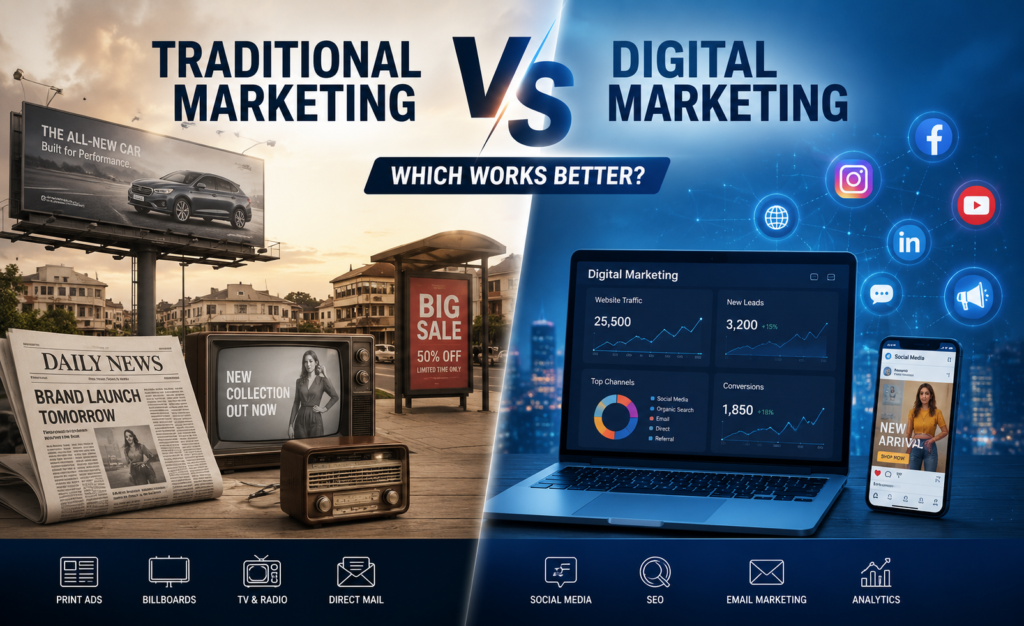
Marketing has always been the bridge between businesses and customers. Whether you’re selling handmade crafts, running a local bakery, or managing a global company, one thing never changes—people need to know you exist before they can buy from you.
For decades, businesses relied on newspapers, television, radio, magazines, billboards, and direct mail to spread their message. These methods shaped consumer behavior and built some of the world’s most recognizable brands.
Then everything changed.
The internet transformed the way people search, shop, communicate, and make purchasing decisions. Today, billions of people spend hours online every day, opening endless opportunities for businesses to connect with their audience.
This shift has sparked one of the biggest debates in modern business:
Traditional Marketing vs Digital Marketing—which one actually works better?
The answer isn’t as simple as choosing one over the other. Each approach has strengths, weaknesses, and ideal use cases. The right choice depends on your business goals, target audience, budget, and industry.
In this comprehensive guide, you’ll discover the major differences between traditional and digital marketing, compare their costs, understand their return on investment (ROI), and learn which strategy can help your business grow in today’s competitive world.
By the end of this article, you’ll have the knowledge to make confident marketing decisions that drive real results.
What is Traditional Marketing?
Traditional marketing refers to promotional methods that existed long before the internet became part of everyday life. These marketing channels use offline media to communicate with customers.
Although digital marketing dominates today’s conversations, traditional marketing continues to influence millions of buying decisions every day.
Imagine driving down a busy highway and seeing a massive billboard promoting a new smartphone. Or watching your favorite TV show only to see a memorable commercial during the break. Maybe you receive a colorful brochure in your mailbox announcing the opening of a nearby restaurant.
These are all examples of traditional marketing.
Unlike online marketing, traditional marketing focuses on reaching audiences through physical or broadcast media. Its goal is to create brand awareness and encourage customers to take action.
Many globally recognized brands still invest heavily in traditional advertising because it helps build trust, credibility, and broad public awareness.
Types of Traditional Marketing
Traditional marketing includes many advertising methods that businesses have used successfully for decades.
Television Advertising
Television commercials combine visuals, storytelling, music, and emotion to leave lasting impressions.
Major companies continue investing millions in TV ads because they can reach enormous audiences in a short period.
Examples include:
- Product launches
- Holiday campaigns
- Brand awareness
- National promotions
Radio Advertising
Radio advertising remains effective for reaching commuters and local communities.
Businesses often use radio promotions for:
- Restaurants
- Car dealerships
- Local events
- Retail stores
- Service businesses
Its relatively lower cost makes it attractive for regional marketing.
Newspaper Advertising
Newspapers have been trusted advertising platforms for generations.
Businesses commonly promote:
- Sales
- Public notices
- Local events
- Job openings
- Store launches
Although readership has declined in many regions, newspapers still perform well among older demographics.
Magazine Advertising
Magazines allow advertisers to target niche audiences.
Examples include:
- Fashion magazines
- Business magazines
- Health publications
- Sports magazines
- Travel magazines
Because readers often keep magazines for weeks or months, advertisements can enjoy a longer lifespan.
Billboard Advertising
Billboards provide continuous visibility.
Placed along highways and busy intersections, they generate thousands of impressions every day.
A strong billboard typically includes:
- Large visuals
- Short message
- Bold branding
- Clear call-to-action
Flyers, Brochures, and Direct Mail
Printed marketing materials remain popular among local businesses.
Examples include:
- Restaurant menus
- Discount coupons
- Real estate brochures
- Event invitations
- Product catalogs
These materials allow customers to physically interact with a brand.
Event Sponsorships
Businesses often sponsor:
- Sports tournaments
- Community events
- Charity programs
- School functions
- Concerts
This builds goodwill while increasing brand visibility.
Advantages of Traditional Marketing
Despite the rise of digital channels, traditional marketing still offers several important advantages.
1. Builds Strong Brand Credibility
Many consumers perceive television commercials, newspapers, and magazines as more trustworthy than online advertisements.
Appearing on established media platforms often increases brand authority.
2. Excellent for Local Marketing
Traditional advertising works exceptionally well when targeting customers within a specific geographic area.
A neighborhood restaurant, local clinic, or retail store can attract nearby customers through newspapers, flyers, or radio advertisements.
3. High Visibility
Billboards and television advertisements are difficult to ignore.
Unlike online ads that users can skip or block, physical advertisements remain visible to everyone passing by.
4. Emotional Storytelling
Television commercials are especially powerful because they combine:
- Visual storytelling
- Music
- Human emotions
- Memorable characters
Some advertisements remain unforgettable for decades.
5. Reaches Less Digitally Active Audiences
Not everyone spends significant time online.
Older adults and rural populations often consume more television, newspapers, and radio than social media.
Traditional marketing helps businesses reach these valuable customer segments.
Disadvantages of Traditional Marketing
Although traditional marketing has many strengths, it also comes with significant limitations.
High Costs
Running television commercials or printing thousands of brochures can require substantial investment.
Small businesses often struggle to compete with larger brands that have massive advertising budgets.
Difficult to Measure Performance
One of the biggest challenges is tracking results.
Questions like these are often difficult to answer:
- Which newspaper generated the sale?
- How many people called after seeing the billboard?
- Which TV commercial produced the highest ROI?
Without accurate data, optimizing campaigns becomes challenging.
Limited Audience Targeting
Traditional marketing typically targets broad audiences rather than specific customer groups.
For example, a billboard is seen by everyone driving past—even people who have no interest in the product.
This reduces efficiency compared to highly targeted online advertising.
Limited Customer Interaction
Traditional marketing is generally one-way communication.
Customers see an advertisement but cannot instantly:
- Ask questions
- Leave comments
- Share experiences
- Purchase immediately
Modern consumers increasingly expect interactive experiences.
Slower Campaign Changes
Once printed or broadcast, advertisements are difficult and expensive to modify.
Changing a newspaper advertisement or billboard often involves additional production costs.
Digital marketing offers much greater flexibility, which we’ll explore next.
What is Digital Marketing?
If traditional marketing represents the past, digital marketing represents the present—and increasingly, the future.
Digital marketing is the practice of promoting products, services, or brands through internet-connected channels. Instead of relying on television or newspapers, businesses connect with customers where they spend a large portion of their time—online.
Think about your own daily routine. You search Google when you have a question, scroll through Instagram or Facebook during breaks, watch videos on YouTube, read emails, or shop online. Every one of these activities creates an opportunity for businesses to reach you with relevant content or advertisements.
Unlike traditional marketing, digital marketing is built on data. Businesses can see who viewed an ad, who clicked it, how much they spent, and even how many sales it generated. This level of insight has transformed the way marketing campaigns are planned and optimized.
For startups, freelancers, and small businesses with limited budgets, digital marketing has opened doors that were once reserved for companies with massive advertising budgets. Today, a single well-planned campaign can reach thousands—or even millions—of people without the cost of television or print advertising.
In the next section, we’ll explore the major types of digital marketing and why they’ve become essential for businesses of every size.
Types of Digital Marketing
Digital marketing is not just one strategy—it is a collection of powerful online techniques that help businesses attract, engage, and convert customers. Each channel has its own strengths, and when combined, they create a marketing engine that works around the clock.
Let’s explore the most effective types of digital marketing.
Search Engine Optimization (SEO)
Search Engine Optimization (SEO) is the process of improving a website so it ranks higher on search engines like Google.
Imagine someone searches for “best running shoes” or “digital marketing agency near me.” If your website appears on the first page of Google, you’re far more likely to receive visitors than websites buried on later pages.
SEO focuses on:
- Keyword research
- High-quality content
- Technical website improvements
- Link building
- User experience
- Mobile optimization
Unlike paid advertising, SEO generates organic traffic that can continue bringing visitors for months or even years.
Pay-Per-Click (PPC) Advertising
PPC advertising allows businesses to display ads on search engines and other platforms while paying only when someone clicks the advertisement.
Popular PPC platforms include:
- Google Ads
- Microsoft Ads
- Amazon Ads
The biggest advantage is speed. Businesses can begin receiving targeted traffic almost immediately after launching a campaign.
Social Media Marketing
Billions of people use social media every day, making it one of the most powerful marketing channels available.
Popular platforms include:
- TikTok
- X (formerly Twitter)
Businesses use these platforms to:
- Build brand awareness
- Engage with customers
- Generate leads
- Promote products
- Create communities
- Provide customer support
Social media allows brands to become more human by interacting directly with their audience.
Content Marketing
Content marketing focuses on creating valuable information instead of constantly promoting products.
Examples include:
- Blog posts
- E-books
- Videos
- Podcasts
- Case studies
- Infographics
- Tutorials
Helpful content builds trust over time. Instead of interrupting potential customers with advertisements, businesses educate and assist them, naturally encouraging future purchases.
Email Marketing
Despite being one of the oldest digital marketing channels, email marketing remains incredibly effective.
Businesses use email to:
- Welcome new subscribers
- Share newsletters
- Announce product launches
- Send promotional offers
- Recover abandoned carts
- Build long-term customer relationships
Since recipients have already chosen to receive emails, engagement rates are often higher than many other marketing channels.
Affiliate Marketing
Affiliate marketing involves partnering with individuals or businesses that promote your products in exchange for a commission.
This performance-based model benefits both parties because affiliates earn income only when they generate sales or leads.
Influencer Marketing
Consumers increasingly trust recommendations from people they follow online.
Influencer marketing allows brands to collaborate with creators who already have loyal audiences.
These partnerships can introduce products to highly engaged communities and create authentic brand awareness.
Video Marketing
Video has become one of the most consumed forms of online content.
Businesses create videos for platforms like:
- YouTube
- Instagram Reels
- Facebook Videos
- TikTok
Videos help explain products, tell stories, demonstrate expertise, and connect emotionally with audiences.
Advantages of Digital Marketing
The rapid growth of digital marketing isn’t accidental. Businesses of every size continue investing in online marketing because it offers remarkable advantages that traditional methods often cannot match.
1. Cost-Effective Marketing
Digital marketing allows businesses to start with relatively small budgets.
Instead of spending thousands of dollars on television commercials or newspaper advertisements, businesses can launch targeted online campaigns with significantly lower investments.
This affordability makes digital marketing ideal for:
- Startups
- Freelancers
- Small businesses
- Local companies
- Entrepreneurs
Even modest budgets can produce meaningful results when campaigns are managed effectively.
2. Highly Targeted Advertising
One of the greatest strengths of digital marketing is precision targeting.
Instead of showing advertisements to everyone, businesses can target audiences based on:
- Age
- Gender
- Interests
- Income
- Occupation
- Geographic location
- Online behavior
- Purchase history
This reduces wasted advertising spend and increases campaign efficiency.
3. Measurable Results
Traditional marketing often leaves businesses guessing.
Digital marketing provides clear performance data.
Businesses can measure:
- Website visitors
- Click-through rates
- Conversion rates
- Cost per lead
- Return on investment (ROI)
- Customer lifetime value
- Bounce rates
- Engagement rates
These insights allow marketers to improve campaigns continuously.
4. Global Reach
A local business can now reach customers across cities, countries, or even continents.
The internet removes geographical limitations, allowing businesses to scale much faster than traditional marketing alone.
5. Real-Time Optimization
Digital campaigns can be adjusted instantly.
If an advertisement isn’t performing well, marketers can modify:
- Headlines
- Images
- Target audience
- Budget
- Keywords
- Landing pages
This flexibility reduces waste and improves results.
6. Better Customer Relationships
Digital platforms encourage two-way communication.
Customers can:
- Ask questions
- Leave reviews
- Share experiences
- Send messages
- Participate in polls
- Join online communities
This interaction helps businesses build stronger, long-term relationships.
7. Higher Return on Investment
Because campaigns can be optimized continuously and targeted precisely, digital marketing often delivers a stronger return on investment than many traditional marketing methods.
Businesses spend less while reaching people who are more likely to become customers.
Disadvantages of Digital Marketing
Although digital marketing offers countless benefits, it isn’t perfect.
Understanding its limitations helps businesses develop realistic expectations.
High Competition
The internet is crowded.
Every day, millions of businesses compete for attention through websites, social media, videos, and advertisements.
Standing out requires creativity, consistency, and patience.
Constant Algorithm Changes
Search engines and social media platforms regularly update their algorithms.
A strategy that works today may need adjustments tomorrow.
Businesses must stay informed and adapt continuously.
Privacy Concerns
Consumers are becoming increasingly concerned about online privacy.
Regulations regarding cookies, data collection, and user tracking continue to evolve, affecting digital marketing strategies.
Requires Technical Skills
Successful digital marketing often involves:
- Analytics
- SEO
- Paid advertising
- Content creation
- Website management
- Marketing automation
Businesses may need training or experienced professionals to maximize results.
Negative Reviews Spread Quickly
While online reviews build trust, negative experiences can spread rapidly.
Businesses must actively monitor their online reputation and respond professionally to customer concerns.
Traditional Marketing vs Digital Marketing: Key Differences
The following table highlights the most important differences between the two approaches.
| Feature | Traditional Marketing | Digital Marketing |
|---|---|---|
| Primary Channels | TV, radio, newspapers, magazines, billboards | Search engines, social media, email, websites |
| Cost | Generally high | Flexible and often lower |
| Audience Targeting | Broad | Highly specific |
| Performance Tracking | Limited | Detailed analytics |
| Customer Interaction | Mostly one-way | Two-way communication |
| Campaign Changes | Slow and expensive | Fast and easy |
| Geographic Reach | Mostly local or regional | Local to global |
| ROI Measurement | Difficult | Accurate and measurable |
| Personalization | Minimal | Highly personalized |
| Speed | Slower | Immediate |
When comparing Traditional Marketing vs Digital Marketing, it’s clear that digital marketing offers greater flexibility and measurable performance. However, traditional marketing still plays an important role in building credibility and reaching audiences that may not spend much time online.
Cost Comparison
Budget is one of the first factors businesses consider when choosing a marketing strategy.
Here’s a general comparison:
| Marketing Activity | Traditional Marketing | Digital Marketing |
|---|---|---|
| Television Ads | Very High | Not Applicable |
| Newspaper Ads | High | Not Applicable |
| Billboards | High | Not Applicable |
| Printing Brochures | Moderate | Not Required |
| Google Ads | Not Available | Flexible Budget |
| Facebook Ads | Not Available | Flexible Budget |
| SEO | Not Available | Long-Term Investment |
| Email Marketing | Not Available | Low Cost |
A startup with limited resources can begin digital marketing with a modest budget and gradually scale as results improve. Traditional marketing often requires larger upfront investments, making it less accessible for smaller businesses.
Audience Reach Comparison
Choosing the right marketing channel also depends on where your audience spends their time.
Traditional Marketing Reaches:
- Local communities
- Newspaper readers
- Television viewers
- Radio listeners
- Older demographics
- People commuting on roads
Digital Marketing Reaches:
- Internet users
- Smartphone users
- Social media audiences
- Online shoppers
- Global customers
- Younger demographics
- Remote consumers
Today’s consumers often begin their buying journey online by searching for reviews, comparing products, or asking questions on social media. Businesses that maintain a strong digital presence are better positioned to meet customers where they already are.
Measuring Results
One of the biggest differences in the Traditional Marketing vs Digital Marketing debate is the ability to measure success.
Traditional marketing often relies on estimates. A business might know how many newspapers were printed or how many viewers watched a television program, but it’s difficult to determine exactly how many customers made a purchase because of a specific advertisement.
Digital marketing provides precise metrics.
Marketers can track:
- Number of website visitors
- Ad impressions
- Click-through rates
- Conversion rates
- Leads generated
- Sales completed
- Revenue earned
- Customer acquisition cost
- Return on ad spend (ROAS)
This data allows businesses to make informed decisions instead of relying on assumptions.
Rather than guessing what works, marketers can continuously improve campaigns using real-world performance data. That level of transparency is one of the reasons digital marketing has become the preferred choice for many modern businesses.
Which Offers Better ROI?
Return on Investment (ROI) is one of the most important metrics in marketing. Every dollar spent should ideally bring measurable value back to the business. Whether that value comes in the form of sales, leads, or brand awareness, understanding ROI helps businesses make smarter decisions.
When comparing Traditional Marketing vs Digital Marketing, digital marketing often provides a stronger ROI for most businesses. The reason is simple: every campaign can be tracked, analyzed, and optimized in real time.
Imagine running two campaigns. One is a billboard on a busy highway, and the other is a Google Ads campaign targeting people searching for “best accounting software.” While the billboard reaches thousands of drivers, it’s difficult to know how many of them actually become customers. The Google Ads campaign, however, can reveal exactly how many people clicked, filled out a form, or completed a purchase.
This ability to measure performance gives digital marketing a significant advantage.
Why Digital Marketing Usually Delivers Higher ROI
- Highly targeted audiences reduce wasted spending.
- Campaigns can be adjusted instantly.
- Every click, lead, and conversion can be measured.
- Businesses can test different advertisements to improve results.
- Marketing budgets can scale based on performance.
For example, if an online advertisement isn’t performing well, marketers can change the image, headline, or audience within minutes. In traditional marketing, replacing a billboard or reprinting thousands of brochures would involve additional time and expense.
When Traditional Marketing Delivers Strong ROI
Although digital marketing often provides better measurable returns, traditional marketing still performs exceptionally well in certain situations.
Traditional marketing can generate impressive ROI when:
- Launching a new product nationally
- Building long-term brand recognition
- Reaching audiences with limited internet access
- Promoting local community events
- Creating memorable emotional campaigns through television
Some of the world’s most successful brands continue investing in television commercials, sponsorships, and outdoor advertising because they understand that trust and visibility cannot always be measured with clicks alone.
ROI Comparison Table
| Factor | Traditional Marketing | Digital Marketing |
|---|---|---|
| Budget Flexibility | Low | High |
| Targeting Accuracy | Moderate | Excellent |
| Performance Tracking | Limited | Detailed |
| Optimization Speed | Slow | Instant |
| Lead Generation | Moderate | Excellent |
| Brand Awareness | Excellent | Excellent |
| Long-Term Growth | Strong | Outstanding |
For most startups, freelancers, and small businesses, digital marketing offers a better balance of affordability, flexibility, and measurable growth.
Which Businesses Should Choose Traditional Marketing?
Traditional marketing is far from obsolete. In fact, it remains a valuable strategy for many organizations that need to reach broad audiences or strengthen their brand presence.
Local Businesses
Restaurants, clinics, grocery stores, furniture shops, and local service providers often benefit from newspaper advertisements, flyers, and local radio campaigns.
A well-designed brochure distributed within a neighborhood can still bring customers through the door.
Large Corporations
Major brands invest heavily in television and outdoor advertising because they aim to stay visible everywhere.
Think about the commercials you see during major sporting events or the giant billboards displayed in city centers. These campaigns create familiarity, and familiarity often builds trust.
Businesses Targeting Older Audiences
Not every customer spends hours scrolling through social media.
Older generations may still prefer:
- Newspapers
- Television
- Radio
- Printed catalogs
For these audiences, traditional marketing remains highly effective.
Luxury Brands
Luxury companies often use premium magazines, exclusive events, and elegant print advertising to reinforce their image.
These channels communicate prestige and exclusivity in ways that resonate with high-end consumers.
Which Businesses Should Choose Digital Marketing?
If your goal is rapid growth, measurable results, and efficient spending, digital marketing is often the better choice.
Startups
Startups typically operate with limited budgets.
Digital marketing allows them to compete with larger companies without spending millions on advertising.
Small Businesses
Local businesses can reach nearby customers using:
- Google Business Profile
- Local SEO
- Facebook Ads
- Instagram Ads
- Email marketing
These tools help attract customers who are actively searching for products or services.
E-commerce Stores
Online stores depend heavily on digital marketing because their customers shop online.
Successful e-commerce brands often combine:
- SEO
- Google Ads
- Social media marketing
- Influencer marketing
- Email campaigns
Together, these channels drive traffic and increase sales.
Freelancers and Consultants
Professionals offering services such as design, writing, coaching, or digital marketing can build authority through valuable content, search engine visibility, and social media engagement.
Digital marketing helps them showcase expertise and generate qualified leads consistently.
Global Businesses
The internet removes geographical barriers.
A business in one country can sell products or services to customers around the world, making digital marketing an essential tool for international growth.
Can Traditional and Digital Marketing Work Together?
Absolutely.
In fact, many successful businesses don’t choose one over the other—they combine both.
This strategy is known as integrated marketing, where multiple channels work together to create a consistent customer experience.
Imagine a company launching a new product.
They might:
- Run television commercials to create nationwide awareness.
- Display billboards in major cities.
- Publish educational blog posts.
- Promote videos on social media.
- Send email campaigns to subscribers.
- Use Google Ads to capture search traffic.
Each marketing channel supports the others.
A customer may first notice the product on television, search for it online later, read reviews, visit the website, and finally make a purchase.
This seamless journey demonstrates why combining traditional and digital marketing often produces stronger results than relying on a single approach.
Benefits of an Integrated Marketing Strategy
- Consistent brand messaging
- Greater audience reach
- Stronger customer trust
- Improved lead generation
- Higher conversion rates
- Better long-term brand recognition
The goal isn’t to decide which method is “better” in every situation. The goal is to choose the right mix for your audience, objectives, and budget.
The Future of Marketing
Marketing continues to evolve as technology changes.
Artificial intelligence, voice search, automation, personalization, and predictive analytics are transforming how businesses communicate with customers.
Consumers now expect:
- Personalized recommendations
- Fast responses
- Helpful content
- Mobile-friendly experiences
- Transparent communication
Businesses that adapt to these expectations will be better positioned for long-term success.
However, one thing will never change.
People buy from brands they trust.
Whether that trust is built through a memorable television commercial or a helpful blog article, genuine relationships remain at the heart of effective marketing.
The future belongs to businesses that embrace innovation while keeping the customer at the center of every marketing decision.
Frequently Asked Questions (FAQs)
1. What is the biggest difference between traditional marketing and digital marketing?
The biggest difference is the communication channel. Traditional marketing uses offline media such as television, newspapers, radio, and billboards, while digital marketing uses online platforms like search engines, websites, social media, email, and mobile apps.
2. Which is more cost-effective?
Digital marketing is generally more cost-effective because businesses can start with smaller budgets, target specific audiences, and optimize campaigns based on real-time data.
3. Is traditional marketing still relevant?
Yes. Traditional marketing remains valuable for building brand awareness, reaching local communities, targeting older demographics, and supporting large-scale advertising campaigns.
4. Can small businesses succeed using only digital marketing?
Many small businesses achieve excellent results using digital marketing alone. Strategies such as SEO, content marketing, email marketing, and social media advertising can generate leads and sales without requiring massive budgets.
5. Which marketing strategy is easier to measure?
Digital marketing is significantly easier to measure. Businesses can track website traffic, conversions, click-through rates, customer behavior, and return on investment using analytics tools.
6. Should businesses combine traditional and digital marketing?
In many cases, yes. Combining both approaches creates a stronger customer experience and allows businesses to maximize reach, engagement, and brand recognition.
7. What skills are important for digital marketing?
Key digital marketing skills include:
- Search Engine Optimization (SEO)
- Content writing
- Social media marketing
- Pay-Per-Click advertising
- Email marketing
- Data analytics
- Marketing automation
- Conversion optimization
Developing these skills helps marketers remain competitive in an increasingly digital world.
Conclusion
The debate over Traditional Marketing vs Digital Marketing isn’t about declaring one winner and abandoning the other. It’s about understanding the strengths of each and using them wisely.
Traditional marketing has built legendary brands, inspired generations, and continues to create lasting impressions through television, print, radio, and outdoor advertising. Its ability to establish credibility and connect with local communities remains powerful.
Digital marketing, on the other hand, has revolutionized how businesses reach customers. It offers unmatched targeting, measurable performance, flexible budgets, and the ability to build meaningful relationships with audiences around the world. Whether you’re a startup, freelancer, small business owner, or global enterprise, digital marketing provides tools to grow efficiently and adapt quickly to changing consumer behavior.
The most successful businesses understand that customers rarely interact with just one marketing channel. They might discover a brand through a billboard, search for it online, read customer reviews, follow it on social media, and eventually make a purchase after receiving an email. Every touchpoint contributes to the customer’s journey.
Instead of asking, “Which marketing strategy is better?”, ask yourself:
- Who is my target audience?
- Where do they spend their time?
- What is my budget?
- What are my business goals?
- How can I create a consistent experience across all channels?
When your marketing strategy is built around your customers rather than your preferences, you position your business for sustainable growth.
In today’s fast-changing world, success belongs to businesses that are willing to learn, adapt, and embrace both proven traditions and innovative technologies. Marketing is no longer just about selling a product—it is about solving problems, creating value, and building trust that lasts.
Recommended External Resource
For reliable marketing research, industry trends, and consumer insights, visit HubSpot’s Marketing Resources: https://blog.hubspot.com/marketing
Key Takeaways
Before diving into the details, here are the most important lessons from this guide:
- Traditional marketing builds trust, brand recognition, and strong local awareness.
- Digital marketing offers better audience targeting, measurable performance, and higher flexibility.
- Small businesses and startups often benefit more from digital marketing because of its lower costs and scalable nature.
- Traditional marketing still plays a valuable role in industries where credibility and mass exposure are essential.
- The most successful businesses combine traditional and digital marketing to create a seamless customer experience.
- Marketing isn’t about choosing one strategy over another—it’s about choosing the right strategy for your audience and goals.
Traditional Marketing vs Digital Marketing at a Glance
| Feature | Traditional Marketing | Digital Marketing |
|---|---|---|
| Primary Channels | TV, Radio, Newspapers, Magazines, Billboards | Google, Social Media, Email, Websites |
| Cost | Higher | Flexible for Any Budget |
| Audience Reach | Local or Regional | Local to Global |
| Targeting | Broad | Highly Specific |
| Customer Interaction | Limited | Two-Way Communication |
| Performance Tracking | Difficult | Real-Time Analytics |
| Campaign Changes | Slow | Instant |
| Personalization | Minimal | Highly Personalized |
| Best For | Brand Awareness | Lead Generation & Sales |
| ROI Measurement | Limited | Accurate & Data-Driven |
Marketing Statistics You Should Know
Numbers tell a powerful story. They reveal how marketing has evolved and where businesses are finding the greatest opportunities today.
Here are a few industry insights:
- More than 5.5 billion people use the internet worldwide, making digital channels an essential part of modern marketing.
- Google processes billions of searches every day, showing how frequently consumers turn to search engines before making purchasing decisions.
- A significant share of global web traffic now comes from mobile devices, highlighting the importance of mobile-friendly websites and campaigns.
- Email marketing continues to deliver one of the strongest returns on investment, with many studies reporting an average ROI of around $36 for every $1 spent, though results vary by industry and execution.
- Consumers increasingly research products online before buying, even when the final purchase happens in a physical store.
These trends emphasize a simple reality: today’s customers expect businesses to have a strong digital presence while still appreciating memorable offline experiences.
Expert Tips for Choosing the Right Marketing Strategy
Every business is unique, which means there is no universal marketing formula. However, these practical tips can help you make smarter decisions and avoid costly mistakes.
1. Start with Clear Goals
Ask yourself:
- Do you want more sales?
- Are you trying to generate leads?
- Do you need stronger brand awareness?
- Are you launching a new product?
Your objectives should determine your marketing strategy—not the latest trend.
2. Understand Your Audience
The best marketing begins with understanding the people you want to serve.
Research:
- Age
- Interests
- Buying habits
- Preferred communication channels
- Online behavior
- Common challenges
The better you know your audience, the more effective your campaigns will be.
3. Invest in Long-Term Assets
Paid advertising can deliver quick wins, but long-term growth often comes from building assets that continue generating value.
Examples include:
- SEO-optimized blog articles
- Educational videos
- Email subscriber lists
- Helpful resources
- Strong customer relationships
These assets keep working even after a campaign ends.
4. Track Every Campaign
Marketing without measurement is simply guesswork.
Monitor important metrics such as:
- Website traffic
- Conversion rate
- Cost per lead
- Customer acquisition cost
- Return on investment
- Customer lifetime value
Regular analysis helps you improve future campaigns and spend your budget wisely.
5. Build Trust Before Selling
Customers rarely purchase from businesses they don’t trust.
Provide value first through:
- Helpful content
- Honest communication
- Educational resources
- Excellent customer service
- Authentic testimonials
Trust takes time to earn, but it becomes one of your greatest competitive advantages.
6. Stay Adaptable
Marketing evolves constantly.
Consumer behavior changes.
Technology changes.
Search engines change.
Social media platforms change.
Businesses that continue learning and adapting are the ones that thrive over the long term.
Common Marketing Mistakes to Avoid
Even experienced marketers make mistakes. Recognizing these common pitfalls can save time, money, and frustration.
Chasing Every New Trend
Not every platform or trend is right for your business.
Focus on the channels where your audience is most active instead of trying to be everywhere at once.
Ignoring Your Target Audience
Creating campaigns without understanding your customers often leads to poor results.
Always ask:
“Who am I trying to help?”
The answer should guide every marketing decision.
Expecting Instant Success
Marketing is a marathon, not a sprint.
SEO takes time.
Brand awareness grows gradually.
Customer loyalty develops through consistent positive experiences.
Patience and consistency are essential.
Neglecting Analytics
Without tracking performance, it’s impossible to know what works.
Use data to improve your campaigns rather than relying on assumptions.
Focusing Only on Selling
Customers don’t want to feel like they’re being sold to every moment.
They appreciate businesses that educate, inspire, and solve problems.
When you consistently provide value, sales often follow naturally.
Inconsistent Branding
Your logo, colors, tone of voice, and messaging should remain consistent across every marketing channel.
Consistency strengthens recognition and builds trust over time.
Final Thoughts
Marketing has never been just about advertisements.
It’s about connecting with people.
It’s about understanding their dreams, solving their problems, and earning their trust one interaction at a time.
Traditional marketing reminds us of the power of storytelling, familiarity, and human connection. A memorable television commercial, a well-designed magazine advertisement, or a thoughtfully placed billboard can leave a lasting impression that people remember for years.
Digital marketing, meanwhile, has transformed the way businesses engage with customers. It offers precision, flexibility, and measurable results that empower companies of all sizes to compete in an increasingly connected world.
But perhaps the greatest lesson is this:
Marketing is not a battle between the old and the new. It is a partnership between proven principles and modern innovation.
Businesses that embrace both approaches thoughtfully are often the ones that build stronger brands, create loyal customers, and achieve sustainable growth.
As you plan your next marketing campaign, don’t simply ask which strategy is better. Instead, ask how you can create meaningful experiences that truly serve your audience. When people feel understood, respected, and valued, they don’t just become customers—they become advocates for your brand.
The future belongs to businesses that are willing to learn, adapt, and connect with authenticity. Let your marketing reflect not only what you sell, but also the value you bring to people’s lives.
References
For trustworthy information and continued learning, explore these authoritative resources:
- HubSpot Marketing Blog – https://blog.hubspot.com/marketing
- Google Search Central – https://developers.google.com/search
- Google Analytics Help Center – https://support.google.com/analytics
- Think with Google – https://www.thinkwithgo
Post-Article Message
Thank you for reading this comprehensive guide on Traditional Marketing vs Digital Marketing. We hope it has helped you understand the strengths, limitations, and practical applications of both approaches. As the marketing landscape continues to evolve, remember that the most successful strategies are built on understanding your audience, delivering genuine value, and adapting to change with confidence.
Pingback: Digital Marketer in Jogeshwari | SEO, Google Ads & Website Development